How to Choose the Right PVC Resin for Your Business
Choosing the right pvc resin affects more than the purchase price. It can influence melt flow, fusion, surface finish, impact strength, and production consistency. A grade that performs well in one line may cause trouble in another. Small differences matter. A stiff pipe compound and a flexible cable compound, for example, need different performance priorities.
James W. Summers, co-author of PVC Handbook, is a useful technical reference for understanding PVC materials. A practical paraphrase of the selection principle is: “Match the resin to the process and the finished product’s performance needs.” This is a paraphrase, not a verified verbatim quotation. Treat it as a starting point, not a substitute for technical data.
Compare K-value, particle characteristics, bulk density, and the supplier’s recommended processing window. Then check those figures against your equipment, formulation, and end-use requirements. Ask suppliers for current specifications and test results. Run a controlled production trial before placing a large order. Watch how the powder feeds, how the melt behaves, and whether finished parts meet your targets. A spreadsheet can narrow the options, but it cannot reveal every production issue. Even experienced buyers can overlook a small mismatch. That deserves a second look.
Assess end-use requirements and PVC’s typical 1.38–1.45 g/cm³ density
How to Choose the Right PVC Resin for Your Business
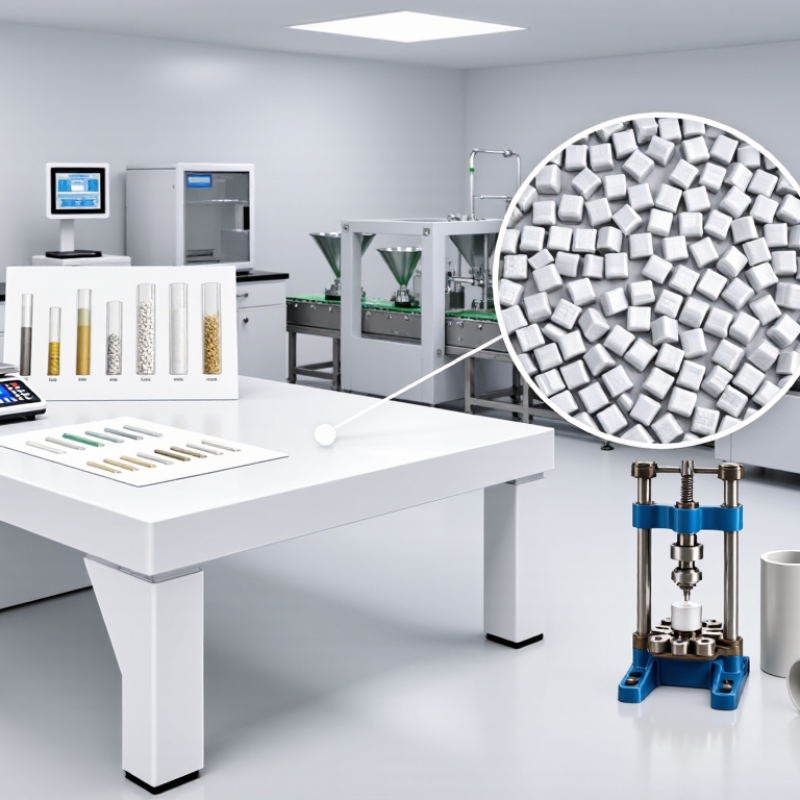
PVC density is a useful screening value, not a buying decision by itself. The typical 1.38–1.45 g/cm³ range applies to solid PVC resin; additives and processing can change a finished compound’s density. At 1.40 g/cm³, one liter of solid resin weighs about 1.4 kilograms. That helps estimate material mass. But silo and feeder performance also depend on pellet shape and bulk density.
End use should guide the grade. A pressure pipe needs reliable fusion and mechanical performance; cable insulation may demand flexibility and consistent electrical properties. The PVC Handbook by Wilkes, Summers, and Daniels (Hanser, 2005) describes PVC’s specific gravity as close to 1.4. ASTM D792-20 and ISO 1183-1:2019 specify methods for measuring plastics density. Compare results only when samples use the same method and conditions. Not the whole story.
Ask for resin test data, then test the formulated compound under your actual process conditions. Check melt behavior, impact performance, and finished-part weight against the application’s requirements. A dense sample can still process poorly. I would not choose a resin from density alone; it is easy to overvalue one tidy number when temperature, additives, and equipment also shape the result.
Choose a K-value: 57–68 covers many common PVC resin applications
When choosing PVC resin, the K-value offers a useful first clue about molecular weight and melt behavior. The 57–68 range covers many common applications, from flexible compounds to rigid profiles and pipe. Lower values generally flow more readily, which can help with filling complex molds. Higher values may support stronger melt strength and finished-part performance, but often need more processing energy.
Small differences matter. A resin near K57 may suit a process that needs easier flow, while a grade closer to K68 may better fit extrusion requiring a stable melt. These are tendencies, not guarantees. Formulation, including plasticizers and stabilizers, can shift the result. So can screw design, temperature settings, and production speed.
Not by itself. K-value cannot tell you exactly how a resin will behave on your line. Check the supplier’s technical data for the test method and relevant processing properties, then compare samples under consistent conditions. Watch the melt, surface finish, and cycle time; even a small change may show up as uneven flow or extra heat. A short production trial is useful, though it may not capture every seasonal or equipment variation. Decide based on the application and process, not the K-value alone.
How to Choose the Right PVC Resin for Your Business — Choose a K-value: 57–68 Covers Many Common PVC Resin Applications
| Typical K-value range |
General resin characteristics |
Common application examples |
Processing considerations |
A useful starting point when… |
| 57–60 |
Relatively lower molecular weight and solution viscosity within this range. Often offers easier flow during processing. |
Injection-molded rigid parts and fittings; selected rigid compounds and extrusion applications. |
Can suit processes that benefit from good flow. Confirm fusion behavior, impact requirements, and formulation compatibility through trials. |
Part geometry is complex or filling a mold is a priority, and the required mechanical properties can be met by the complete formulation. |
| 61–64 |
Intermediate molecular weight and viscosity, providing a balance between processability and finished-product properties. |
General-purpose rigid profiles, sheets, fittings, and other extrusion or molding compounds. |
May provide a practical balance for production, but actual throughput and fusion depend on equipment, additives, and operating conditions. |
You need a versatile starting range for a rigid product and are still optimizing the formulation or process. |
| 65–68 |
Relatively higher molecular weight and solution viscosity within this range. Melt viscosity is generally higher than for lower-K resin. |
Pressure and non-pressure pipe compounds, conduit, rigid profiles, and selected sheet applications. |
May require closer attention to processing temperature, shear, fusion, and equipment capacity. Evaluate impact, strength, and surface requirements in finished-product tests. |
Product performance requirements favor a higher-molecular-weight resin and the processing line can handle its flow and fusion characteristics. |
Selection note: K-value is an indicator derived from the viscosity of a PVC solution and is commonly used to compare resin molecular-weight characteristics. It is not a complete grade specification. Confirm the applicable test method and review factors such as particle characteristics, bulk density, porosity, additive package, processing equipment, and finished-product requirements before selecting a resin.
Select suspension, emulsion, or bulk PVC to match the production process
Choose PVC resin around the process and the finished product, not just the quoted price. Suspension PVC is the usual starting point for rigid pipes, profiles, and fittings. Its particles flow well in dry blends and suit high-volume extrusion. Emulsion PVC forms finer particles, making it useful for pastes, coatings, and flexible flooring. Bulk PVC can offer high purity, but process control and equipment compatibility need careful review.
PlasticsEurope’s Plastics – the Fast Facts 2024 reports
413.8 million tonnes
of global plastics production in 2023. That scale makes resin selection consequential, but the figure does not tell you which grade will run best. Check particle size, porosity, plasticizer uptake, and thermal stability against your line conditions. A resin that performs well in a supplier’s sample test may behave differently after a full production shift. Test it first.
Tips: Run a small trial using your actual mixer, additives, and processing temperatures. Record torque, fusion time, surface finish, and scrap rate. Then compare results with your product specification. One detail is easy to miss: operators may adjust settings to compensate for a poor resin match, hiding the real issue. Recheck the data before scaling up.
Validate processing conditions; PVC conversion commonly occurs around 160–200°C
How to Choose the Right PVC Resin for Your Business
PVC conversion commonly occurs around 160–200°C, but this range is only a starting point. Resin choice should match your actual process, not a catalog description alone. Check the intended product, equipment type, throughput, and required surface finish. A resin that flows well in one extruder may behave differently in injection molding. Small differences in stabilizers, lubricants, and filler levels can also shift fusion behavior. Test samples under production-like conditions before committing to a large order.
Tips: Record melt temperature, screw speed, pressure, and cycle time during each trial. Inspect for discoloration, rough edges, bubbles, or uneven flow. Change one variable at a time. Test first. Keep notes; memory is unreliable.
Do not treat the 160–200°C range as a fixed recipe. Measure material temperature where possible, since barrel settings may not reflect the resin’s true thermal history. PVC can degrade with excessive heat or residence time, while insufficient heat may leave it poorly fused. Ask suppliers for relevant technical data, then verify it on your own line. If results are inconsistent, investigate moisture, feeding, and equipment wear before blaming the resin. A short, controlled trial can reveal issues before full production.