2026 Top Types of Steel Cable Tray for Global Buyers?
Global buyers entering the 2026 cable-management market face more choices than thicker steel and lower prices. A Steel Cable Tray must match load, span, environment, installation method, and future expansion. One project may need ladder tray for heavy power cables. Another may require perforated tray for smaller control cables and improved ventilation. Wire mesh tray can suit data rooms where quick routing matters. The correct choice is rarely universal.
Electrical safety specialist Mark Earley has stated, “Good electrical design begins with understanding the installation environment.” That principle remains highly practical for cable-tray selection. Buyers should examine zinc-coated, hot-dip galvanized, stainless steel, and powder-coated finishes. Coastal air can attack ordinary coatings. Chemical plants demand stronger resistance. Indoor commercial buildings may need a simpler finish. Small details matter, including splice plates, covers, bends, support spacing, and grounding continuity.
This guide compares the top Steel Cable Tray types expected to attract global buyers in 2026. It considers carrying capacity, corrosion protection, ventilation, installation speed, maintenance, and total ownership cost. Product brochures often look convincing. Real sites are less tidy. Dust collects, cables grow, and supports sometimes face unexpected loads. That is where selection can fail.
There is no perfect tray.
Buyers should also verify manufacturing quality, dimensional consistency, test documentation, and supplier experience. Regional standards and project specifications may differ. A tray that performs well in a dry warehouse may disappoint beside a marine terminal. This article offers a practical framework, but engineers must confirm every choice against actual drawings, site conditions, and approved safety requirements.
What Is a Steel Cable Tray and Why Does Its Type Matter?
2026 Top Types of Steel Cable Tray for Global Buyers
A steel cable tray is a structural pathway for supporting and routing power, control, and data cables. It keeps cables elevated, organized, and easier to inspect. Common designs include ladder, perforated, and solid-bottom trays. Each type affects ventilation, mechanical protection, drainage, and installation time.
Type selection matters because project conditions rarely match a catalogue photo. Ladder trays suit heavy cables and long industrial runs, where airflow reduces heat buildup. Perforated trays support smaller cables and offer convenient fixing points. Solid-bottom trays provide stronger protection from falling dust, dripping liquids, and accidental impact. Galvanized steel works well in many indoor and outdoor environments, while stainless steel is more suitable for aggressive moisture or chemical exposure. Check load ratings, span distances, cable fill, grounding continuity, and local installation requirements. A tray can look strong and still deform when supports are spaced too widely.
Tips: Measure the real cable bundle, not the planned bundle. Leave room for future circuits. Confirm corrosion exposure before choosing the finish. Inspect edges for burrs, especially near communication cables. Field conditions can change, and no selection is perfect. A careful review still prevents expensive rework.
How Are Steel Cable Trays Classified by Structure and Installation Method?
2026 Top Types of Steel Cable Tray for Global Buyers
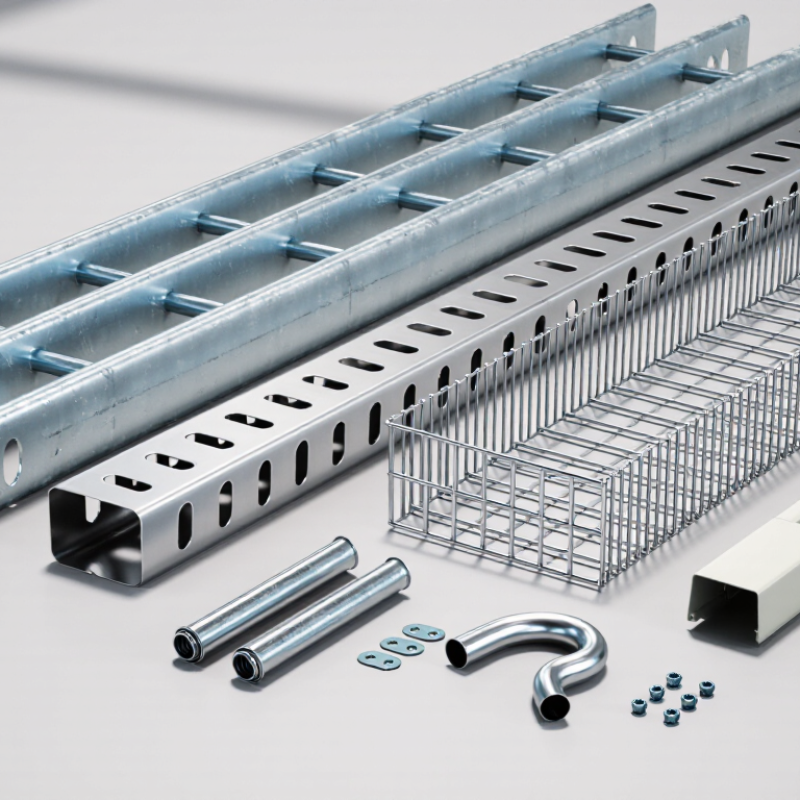
Steel cable trays are commonly classified by structure. Ladder trays use two side rails and rungs, offering strong ventilation and easy cable access. They suit power cables with higher heat output. Perforated trays provide a continuous base with ventilation holes. They support control and communication cables well. Solid-bottom trays protect cables from falling dust and dripping water. However, heat can build up without careful cable spacing. Wire mesh trays are light, flexible, and practical for short indoor routes. Channel trays suit smaller cable groups and compact equipment connections.
Installation methods create another useful classification. Horizontal trays usually rest on trapeze supports, wall brackets, or floor-mounted frames. Vertical runs need frequent brackets to control cable weight and movement. Ceiling suspension saves floor space in workshops and service corridors. Wall-mounted trays work well beside machinery, although access may become difficult after installation. Raised-floor routes can keep sensitive cables organized, but they require accurate coordination with panels and ventilation paths.
In field work, I check tray width, load rating, support spacing, and cable bend radius before fixing steel sections. I also inspect coating damage after cutting and repair exposed areas with an approved protective treatment. Bonding between tray sections matters where metallic continuity is required. A neat drawing can still fail on site. Uneven walls, crowded supports, and late cable changes often force adjustments. No single structure fits every project.
2026 Top Types of Steel Cable Tray for Global Buyers
Steel cable trays are commonly classified by structural form and installation method. The chart compares indicative ventilation opening levels for four widely specified steel tray structures. Actual values vary according to tray width, perforation pattern, wire diameter, and manufacturer design.
Structural classification: ladder, perforated, solid-bottom, and wire-mesh trays. Typical installation methods include horizontal, vertical, overhead, and wall-mounted routing. Ventilation percentages are representative engineering ranges expressed as approximate midpoints, not market-share data.
Which Steel Cable Tray Types Suit Different Industrial Environments?
Steel cable tray selection should start with the environment, not the purchase price. The IEA’s Electricity 2024 report projects data-centre electricity demand to exceed 1,000 TWh by 2026. More computing creates denser, warmer cable routes. Ladder trays suit power feeders because open rungs improve airflow and inspection. They also support heavy cables when installed under IEC 61537 requirements. In dusty production areas, however, open trays may expose cables excessively.
Perforated trays fit control, instrumentation, and mixed industrial circuits. Their side rails protect cables while slots provide ventilation and fixing points. Solid-bottom trays offer stronger protection from falling dust, oil mist, and small debris. Heat can accumulate beneath bundled conductors. Cable ampacity requires checking against applicable electrical codes, including NFPA 70 provisions.
Wire-mesh trays work well for data and communication cables needing frequent additions. They are light, visible, and easy to modify. Not every mesh system handles high mechanical loads.
Outdoor, coastal, and chemical areas require the correct steel finish. Hot-dip galvanized steel suits general outdoor exposure. Stainless steel performs better during salt exposure, washdown, or chemical contact. Uptime Institute’s 2023 Global Data Center Survey identified power-related failures among leading outage causes. That supports separated routes and accessible inspection paths. I would not specify a tray from drawings alone. Cable weight, span, temperature, dust, and corrosion testing still need field verification. Small details matter.
How Should Global Buyers Compare Materials, Standards, and Load Capacity?
2026 Top Types of Steel Cable Tray for Global Buyers?
How Should Global Buyers Compare Materials, Standards, and Load Capacity?
Global electricity demand is forecast to grow by about 4% in both 2024 and 2025, according to the IEA Electricity 2024 report. More power projects mean tougher cable-management decisions. Buyers should compare material, testing, and load data together. Pre-galvanized steel suits dry indoor rooms. Hot-dip galvanized steel performs better outdoors. Stainless steel resists chlorides and chemical exposure, but its cost is higher. Aluminum reduces weight, yet it may need careful separation from dissimilar metals.
Standards matter. IEC 61537 evaluates cable tray systems, including mechanical strength and electrical continuity. NEMA VE 1 provides load and span classifications for metal trays. These systems are not interchangeable automatically. Check the test method, support spacing, allowable deflection, and corrosion category. A tray rated at 150 kg per meter may fail when supports move from 1.5 meters to 2.4 meters. Cable fill, short-circuit forces, seismic movement, and wind loads also deserve review. A clean catalogue table can still mislead.
Tips: Ask for tested load curves, not only a maximum load number. Confirm coating thickness and salt-spray evidence. Request the exact standard edition. Leave expansion space at long straight runs. Recheck calculations after adding spare cables. That small step prevents expensive changes later.
What Factors Determine the Best Steel Cable Tray for an International Project?
2026 Top Types of Steel Cable Tray for Global Buyers
The best steel cable tray depends on the project environment, not only its price. Ladder trays suit heavy power cables because their open rungs improve ventilation and reduce weight. Perforated trays provide better support for control cables and smaller wiring. Solid-bottom trays protect sensitive cables from dust, falling particles, and water splashes. Wire-mesh trays can simplify routing changes in crowded technical rooms.
International projects require careful attention to load capacity, span length, corrosion exposure, and installation conditions. A coastal plant may need hot-dip galvanized or stainless steel construction. Indoor commercial areas may require less protection, but fire performance still deserves verification. Check cable fill, bend radius, tray thickness, and support spacing together. They affect safety. Project teams should also compare regional standards, metric dimensions, grounding methods, and available accessories. A tray that fits one country’s fittings may create delays elsewhere. That detail is easy to underestimate.
Tips: Request test reports, coating information, load tables, and dimensional drawings before ordering. Confirm packaging for long-distance transport. Inspect cut edges and finish quality on arrival. Do not assume the heaviest tray is the best choice. Overdesign increases cost and handling effort. A better decision balances protection, ventilation, installation time, maintenance access, and future expansion. Recheck the design after site measurements; drawings are sometimes optimistic.