

Your Compounder of Choice

Mon - Fri: 8:00 - 16:30 | Sat & Sun: Closed

What Is a Solar Water Pump and How Does It Work?

Solar energy is expanding quickly, but its value is measured in more than installed capacity. IRENA’s Renewable Capacity Statistics 2024 reports that global solar photovoltaic capacity reached about 1,419 gigawatts by the end of 2023. That growth helps explain rising interest in practical solar applications, including water supply. Yet a large global total does not guarantee a suitable pump for every farm, home, or remote site.

A Solar Water Pump uses electricity from solar panels to move water from a well, borehole, river, or storage tank. Panels generate direct-current power as sunlight reaches their cells. A controller manages the electricity and protects the pump; some systems also use an inverter to run an alternating-current motor. Water may flow directly into a tank, where it remains available after clouds pass. Batteries are possible, but they add cost and maintenance. Often, storage is simpler.

The details matter. Pump output depends on sunlight, water demand, lifting height, and pipe losses. A deep borehole with a narrow pipe needs a different setup from a shallow well filling a nearby tank. System sizing should use measured site conditions, not panel wattage alone. Seasonal changes can reduce output when irrigation demand is highest. That deserves attention. Solar pumping can lower dependence on grid power or fuel, but it is not automatically cheaper or more reliable everywhere. A careful design begins with the water source, required daily volume, and total pumping head. IRENA’s capacity data describes the wider solar trend; it does not predict performance at an individual site.
What Is a Solar Water Pump and How Does It Work?

What a Solar Water Pump Is

A solar water pump is a pumping system powered by electricity from solar photovoltaic panels. Its main parts are the panels, an electrical controller, a pump, and pipes that carry water to a field, tank, or household supply. Some pumps sit above ground and draw from shallow sources; submersible models operate underwater in wells. The system does not create water. Its output depends on sunlight, pump capacity, water depth, and the source’s available yield.

Many installations pump water when sunlight is available and store it in a raised tank for later use. Batteries are possible, but they add cost and maintenance; water storage may be simpler. One detail is easy to overlook: matching the pump to the well matters as much as choosing enough panels. An oversized pump can draw water faster than a source recovers. It is not magic.

The International Renewable Energy Agency’s Renewable Power Generation Costs in 2023 report says global weighted-average solar photovoltaic electricity costs fell about 90% from 2010 to 2023. That figure describes power-generation costs, not the purchase or operating cost of an individual pump. Still, it helps explain why solar pumping has become more practical in sunny, off-grid locations. Actual performance varies. Dust on panels, cloudy days, and seasonal water levels can all change how much water reaches a tank.

The Main Components of a Solar Water Pumping System

A solar water pumping system turns sunlight into a controlled flow of water. Its main components are a photovoltaic array, a controller, a motor, a pump, and pipes or storage. The array’s size depends on the required flow, pumping depth, and available sunlight. A shaded panel can reduce output, even when the rest of the system is correctly sized.

The controller connects the panels to the motor and manages power delivery. Some controllers adjust motor speed as sunlight changes; others include dry-run protection to prevent damage when a well runs low. The motor drives a submersible or surface pump, selected for the water source and lift height. Small details matter. A mismatch between pump capacity and well yield can cause poor performance, and calculations should be checked against measured site conditions.

Pipes carry water to a tank, field, or livestock trough, while a float switch or level sensor can stop pumping when a tank is full. Battery storage is optional; many systems instead store water in a raised or ground-level tank. The FAO’s AQUASTAT database reports that agriculture accounts for about 70% of global freshwater withdrawals, underscoring why pump sizing and water management matter. IRENA’s Renewable Power Generation Costs in 2023 reports a global weighted-average solar PV electricity cost of USD 0.044 per kilowatt-hour for new utility-scale projects. That figure is not a small-pump price, though it reflects broader solar cost trends. Not always. A site assessment remains essential.

What Is a Solar Water Pump and How Does It Work?

A solar water pumping system uses electricity from photovoltaic panels to run a pump, moving water for uses such as irrigation, livestock, or household supply.

Chart: Theoretical hydraulic power required to lift water 30 metres at different flow rates. Values are calculated using water density, gravity, flow rate, and lift height; they do not include pump or motor losses.

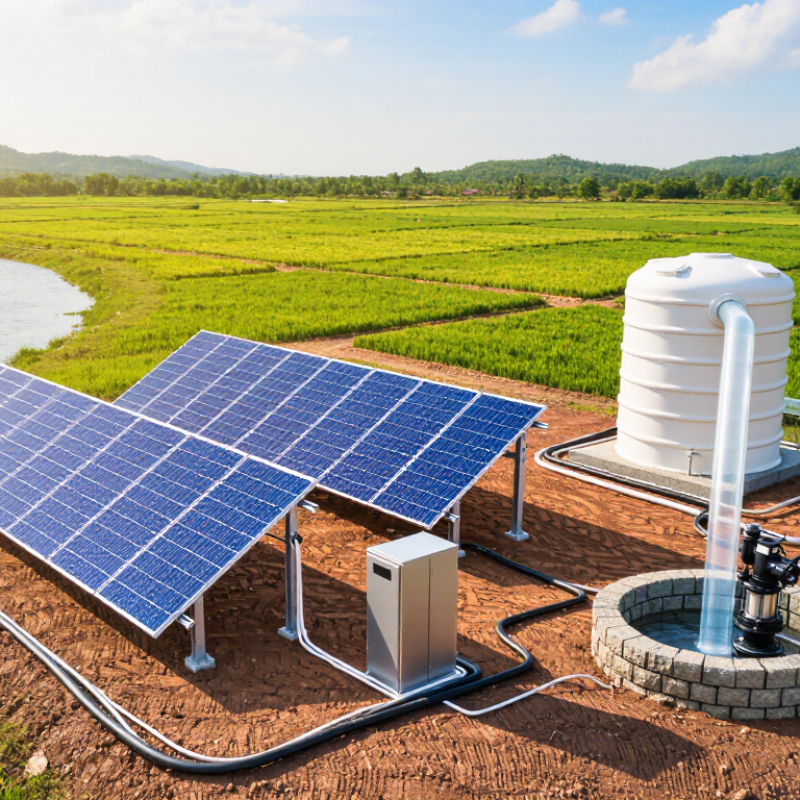
Main components: Solar panels generate electricity; a controller manages power to the pump; the pump moves water; and pipes carry it to storage or its point of use. A water tank can store pumped water for later use.

How Solar Panels Supply Power to the Pump

A solar water pump uses electricity from photovoltaic panels to move water from a well, tank, or other source. Sunlight reaches the panels, and their cells convert it into direct-current electricity. Wires carry this power to a controller, which regulates the supply and helps protect the pump from electrical stress. The motor then turns an impeller or other pumping mechanism. Water starts moving. Simple, but the details matter.

Tips: Match the panel output to the pump’s voltage and power requirements. Use suitable cable sizes and weather-resistant connections. A controller designed for the system can help manage changing sunlight. Batteries are optional; without them, pumping may slow or stop when clouds pass.

In bright midday sun, a properly matched system may deliver more water than it does early in the morning. Output also depends on panel angle, shading, water depth, and the pump’s lift requirements. A shaded corner of one panel can reduce performance, sometimes more than expected. Battery storage can provide power after sunset, but it adds cost and maintenance. In many setups, storing water in a raised tank is simpler. Check the manufacturer’s technical specifications and have an experienced installer assess the site; estimating from panel wattage alone is not always reliable.

How Water Moves from the Source to Its Destination

A solar water pump moves water by converting sunlight into electricity that runs a pump. Sunlight reaches photovoltaic panels, and a controller regulates the power sent to the motor. The pump draws water through an intake from a well, pond, tank, or other source. A submersible pump sits underwater, while a surface pump draws water from above the source. The right setup depends on water depth and the lift required.

From the pump, water travels through pipes toward its destination, such as an elevated storage tank or irrigation line. The pump must overcome vertical lift and resistance inside the pipes; longer or narrower pipes can reduce flow. Small details matter. A leaking joint, clogged screen, or intake too close to muddy sediment can interrupt delivery. When water is stored in a tank, it can remain available after sunlight fades, though the tank must be sized for expected use. Direct pumping may be simpler, but flow can vary with cloud cover. It is easy to underestimate that variation. Checking the source level, pipe route, and daily demand helps determine whether the system can deliver enough water consistently.

Common Solar Water Pump Types and Uses

A solar water pump uses photovoltaic panels to power a motor that moves water from a well, borehole, pond, or canal.

The common types are submersible and surface pumps. Submersible models sit underwater and suit deeper wells; surface pumps draw from nearby, shallow sources. Some systems pump directly when sunlight is available, while others use batteries or a raised storage tank to provide water later. The tank is often simpler to maintain than batteries, but it needs space and correct sizing.

These pumps serve livestock troughs, household water supplies, and small farms using drip or sprinkler irrigation.

FAO estimates that agriculture accounts for about 70% of global freshwater withdrawals, making careful irrigation design important.

IRENA’s Renewable Power Generation Costs in 2023 reports that utility-scale solar photovoltaic electricity costs fell about 90% from 2010 to 2023; that trend does not, by itself, guarantee a low-cost pumping system.

Pump size, well depth, daily water demand, and seasonal sunlight all affect performance. A planning mistake is treating sunny hours as a guaranteed water supply. Clouds, sediment, and dry-season water levels can change the result.

Small systems differ. A local water-source assessment helps match the pump to the actual site.