

Your Compounder of Choice

Mon - Fri: 8:00 - 16:30 | Sat & Sun: Closed

How to Choose the Right Rubber Pad in 2026?

Choosing the right Rubber Pad starts with the job it must perform. Will it absorb vibration beneath a machine, protect a workbench, or cushion a moving part? A pad that feels firm in your hand may compress too much under load. One that resists wear may transmit more vibration than expected. Small details matter: temperature, oil exposure, pad thickness, surface texture, and how the load is distributed.

The market is broad, but broad figures need care. Grand View Research estimated the global rubber market at USD 46.71 billion in 2023 and forecast a 4.8% compound annual growth rate from 2024 to 2030. That report covers rubber overall, not Rubber Pads alone. It signals a large materials sector, not a specific pad-performance guarantee. Polymer scientist James E. Mark’s Polymer Data Handbook is a useful technical reference for understanding how polymer composition relates to material properties. I could not verify a verbatim statement from Mark specifically about choosing Rubber Pads, so I will not invent one. That distinction matters. Compare published hardness, compression set, operating-temperature range, and chemical-resistance data against your actual conditions. Ask for test methods, not just adjectives. “Heavy-duty” is not a measurement. A practical choice may still involve compromise: softer pads can isolate vibration well, yet deform more under sustained weight. Match the compound to the load, then check the real installation. An imperfect fit can look fine at first. The wear marks tell another story.
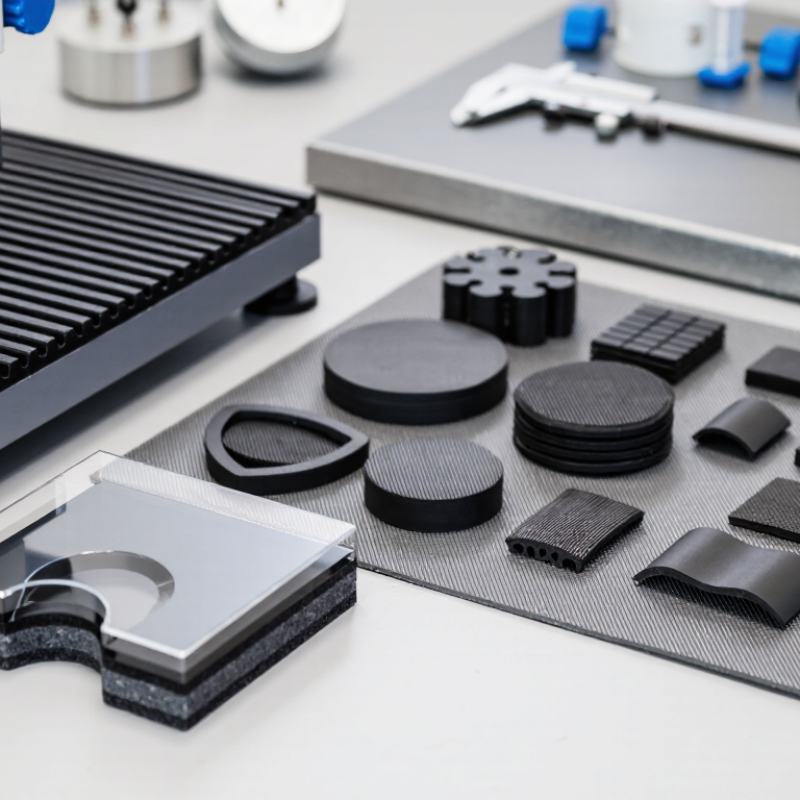
How to Choose the Right Rubber Pad in 2026?

Define the Purpose and Operating Requirements of the Rubber Pad

Start by defining the pad’s job: sealing a joint, reducing vibration, spreading a load, or cushioning impact. Then record the operating details: static or repeated force, contact area, movement, temperature range, and exposure to oils, water, or sunlight. A pad beneath a vibrating pump faces different demands from one supporting a stationary cabinet. Specify hardness only after these conditions are clear. ASTM D2240 uses a 0–100 durometer scale, but hardness alone does not predict load capacity or service life.

Tips: Measure the available space and note sharp edges or uneven surfaces. These small details can change how a pad deforms. Keep the measurements.

For repeated compression, review compression-set data under conditions close to the real application. ISO 815-1 describes how compression set is measured after specified compression and recovery; compare test conditions, not just headline values. Ask suppliers for the test temperature, duration, and sample thickness. A result from a short, warm test may not represent years of cool, cyclic use. One early estimate may miss the mark, so trial the chosen pad under realistic loads before finalizing the specification. The extra check can feel fussy, but replacing a flattened pad is rarely simpler.

Compare Rubber Types and Their Performance Properties

Choosing a rubber pad starts with its working conditions, not a material name. Natural rubber rebounds well and resists abrasion, making it useful under repeated movement. But sunlight, ozone, and oils can shorten its service life. SBR often offers practical wear resistance at a lower cost, though heat and outdoor exposure may limit performance. Small differences matter.

Neoprene handles weathering and moderate oil exposure, so it suits many general-purpose pads. Nitrile is a stronger candidate around oils and greases, but it is not automatically best outdoors. EPDM tolerates water, steam, and weather well, yet performs poorly with petroleum oils. Silicone keeps flexibility across a broad temperature range, although sharp edges and repeated tearing can damage it. These are useful tendencies, not guarantees.

Compare hardness, compression set, thickness, and temperature limits alongside chemical resistance. A pad that feels firm in your hand may still compress too much under a heavy machine. Check the actual load and contact surface; uneven concrete can concentrate pressure at one edge. Ask for test data that matches the intended temperature and fluid exposure. In practice, one property is easy to overvalue. A neat comparison chart can hide the effect of daily vibration, cleaning, or installation errors, so trial a sample under realistic conditions when possible.

Choose the Pad’s Shape, Thickness, and Load Capacity

A rubber pad works best when its shape matches the surface it must support. Round pads suit feet and small contact points, while rectangular pads can spread weight beneath a rail or machine base. Measure the footprint before ordering. A pad that overhangs may catch an edge; one that is too small can concentrate pressure.

Thickness affects cushioning and stability. Thin pads limit movement, while thicker pads can absorb more vibration but may compress or allow equipment to rock. Check the pad’s rated load and compare it with the weight at each support point, not just the machine’s total weight. Include moving forces, such as a motor starting, when relevant. A load rating from a product specification is more reliable than judging softness by hand. One detail is easy to miss: uneven floors can shift the load onto fewer pads.

Tips: Measure the contact area, floor gaps, and expected load before choosing. Leave room for compression, and check that the pad material suits the temperature and environment. If the setup still feels unstable, reassess the load distribution rather than simply adding thickness.

Check Environmental Conditions and Compatibility

A rubber pad can sit beside hot machinery, oily residue, wash water, or direct sunlight. Match the compound to the actual exposure, not just the room temperature. The IPCC’s 2021 assessment reported that global surface temperature in 2011–2020 was about 1.09°C above the 1850–1900 average. That global figure does not predict a site’s conditions, but it is a reminder that outdoor pads may face changing heat and weather. Measure surface temperature, note chemical contact, and check whether exposure is continuous or occasional.

Compatibility matters. ASTM D2000 classifies rubber heat-resistance grades from 70°C to 250°C; these are classification limits, not a promise of service life. For liquid exposure, ASTM D471 provides a method to assess changes in rubber after immersion. Ask for test results matching your fluid, concentration, temperature, and exposure time. A pad that resists oil may still swell or soften in a cleaning agent. Fit matters. Check thickness and compression, too: a chemically suitable pad can still creep under sustained load. One easy mistake is testing a clean sample, then installing it where grit and moisture collect. Test it wet. Recheck the pad after a realistic trial, because site conditions rarely stay perfectly controlled.

Verify Product Specifications and Plan for Installation and Maintenance

How to Choose the Right Rubber Pad in 2026?
Verify Product Specifications and Plan for Installation and Maintenance

Check the actual service conditions before comparing prices. Record the load, expected deflection, operating temperature, and exposure to oil, water, or sunlight. Ask for the compound, hardness, dimensions, and compression-set results. ASTM D2240 measures hardness, while ISO 815-1 covers compression set. These figures help compare products, but they do not replace application-specific testing. Small details matter.

Installation can undermine a suitable pad. Confirm that the supporting surfaces are clean, level, and free of sharp edges. Align the pad carefully; uneven contact can concentrate loads and cause early wear. The U.S. Geological Survey’s Mineral Commodity Summaries 2025 estimates global natural-rubber production at roughly 14 million metric tons in 2024. That market figure is not a quality rating. Request batch-specific test certificates and confirm that the stated material suits your environment.

Plan inspections around the equipment’s duty cycle, not just the calendar. Look for cracks, swelling, permanent flattening, edge extrusion, and loose fasteners. Record pad thickness and take photos from the same angle each time. Replace a pad when damage affects its fit or function, and check the cause before installing another. A mismatch in load or chemical exposure may simply repeat the failure. We sometimes overlook that.

How to Choose the Right Rubber Pad in 2026? — Verify Product Specifications and Plan for Installation and Maintenance
Selection factor What to check Practical guidance Before ordering or installation
Load and contact area Maximum static and dynamic load, load distribution, and the pad’s rated capacity. Estimate average pressure as load divided by the effective contact area. Uneven or concentrated loads can create higher local pressure than the average. Compare the calculated loading with the manufacturer’s stated limits and test conditions. Allow for movement, impact, and safety requirements where applicable.
Rubber compound Compatibility with water, oils, fuels, cleaning agents, weather, ozone, and other exposures. EPDM is commonly selected for outdoor weather and water exposure; NBR is commonly considered for oil exposure; natural rubber is often used where resilience and abrasion resistance are important. Suitability depends on the specific formulation. Request a chemical-compatibility assessment for the actual fluid, concentration, temperature, and exposure duration. Do not select by polymer name alone.
Operating temperature Continuous and peak service temperatures, including cold starts and temperature cycling. Temperature limits vary substantially by compound and formulation. Heat and cold can change stiffness, flexibility, and service life. Check the product data sheet for both continuous and intermittent limits, and confirm that the stated limits apply to the intended environment.
Hardness and flexibility Shore A hardness, thickness, and required compression or vibration isolation. Hardness is commonly reported on the Shore A scale. A softer pad may deform more; a harder pad may provide less deflection. Hardness alone does not establish load capacity or isolation performance. Verify the test method and tolerance, such as ASTM D2240 or ISO 48-4, and request performance data at the expected load where needed.
Dimensions and tolerances Length, width, thickness, hole pattern, flatness, and dimensional tolerances. Dimensions affect fit, contact area, and load distribution. Molded, cut, or fabricated parts may have different tolerances. Check a dimensioned drawing against the equipment and mounting surface. Confirm whether dimensions are nominal or finished-part tolerances.
Compression and recovery Compression set, deflection under load, and ability to recover after compression. Compression set is a laboratory measure of deformation remaining after a specified compression, time, and temperature; it is not a direct guarantee of service life. Compare results only when the test method and conditions match. Ask for the applicable test report, such as ASTM D395 or ISO 815-1.
Surface and mounting Surface finish, friction needs, fasteners, adhesive requirements, and possible movement. A clean, even support surface helps the pad sit uniformly. Adhesives and mechanical fasteners should be compatible with the rubber compound and the surrounding materials. Follow the supplier’s preparation and bonding instructions. Do not assume an unbonded pad will remain in place under shear or vibration.
Installation conditions Alignment, cleanliness, seating, compression, and access for inspection. Remove dirt, oil, burrs, and sharp edges that could damage the pad. Avoid twisting, stretching, or trapping debris during installation. Install to the equipment or product instructions. Record the pad location and any specified torque, preload, or adhesive cure time.
Inspection and maintenance Cracks, cuts, swelling, hardening, permanent flattening, slippage, and loose fasteners. Inspection frequency should reflect load, exposure, operating hours, and the consequence of failure. There is no single interval appropriate for every application. Set an initial inspection schedule, document findings, and shorten intervals if deterioration or movement is observed. Replace damaged pads and investigate the cause.
Documentation and quality Product data sheet, drawing revision, material identification, test reports, and batch traceability. Values are meaningful only when their test methods, conditions, and tolerances are stated. Confirm the delivered part matches the approved specification and retain relevant documentation for future replacement.

Note: Rubber properties and service limits vary by formulation and test conditions. Treat this guide as a selection checklist, and confirm application-specific requirements with the product data sheet and qualified engineering guidance.

Article Source: